
editorialteam
Well-Known Member
Grows vegetables in minimum available water and land without any chemicals
In the present era farming practices needs to move from maximum to minimum in terms of using natural resources precisely water and land. Both are getting scarce with each passing day. Mrs. Nandini Diesh and Mr. Ramneesh developed an upgraded adaptation of squarefoot garden re-designed to suit Indian farming conditions. It is used for growing vegetables organically in the cities. Soon they were joined by four other members Mr. Dinesh Sharma, Mr. Vijay Bhasin, Mr. Rudra Mahapatra and Mr. Amit Rana. All of them are based at Noida, Uttar Pradesh. Ms. Nandini, a corporate lawyer by profession now is passionate farmer as well. She shares details on farming with constraints, seeds, importance of eating seasonal vegetables and future plans. Excerpts:

Mrs. Nandini Diesh
Gone are the days of flood irrigation as now we have to use every single drop of water with utmost care and conscious. Secondly we hardly have open fields left so it has become mandatory to learn to grow food in minimum available space. Farming with these two prime constraints is challenging but not impossible! We found the solution in squarefoot garden. We have used the concept of this model but we have restructured it completely to the requirements of Indian soil.
First step was to identify the right piece of land to grow veggies. All of us together searched for farmland at Khedi Bhanauta village, 25 km from Noida. Land owner Mr. Vikrant Tongad being an environmentalist could understand our goals and objectives behind our farming project hence gave us the land on lease at Rs. 12 thousand per year.
In our model of farming, we have created a matrix of 3*3 square pits. Each square is dug in the dimension of 1.5m(l)*1.5m(b)*8 inches(deep). In the center of the square there is thick green mulch/compost made from green garden waste. The mulch provides all the nutrients to the crops grown in the square and enhances the humus in the soil. It also holds the rainwater and manually poured water naturally. Consequently the moisture is retained well in the soil that drastically reduces the water requirements. We water our field only once in a month. We keep adding mulch in the squares as and when needed. We had 9 such matrix all over the farm.
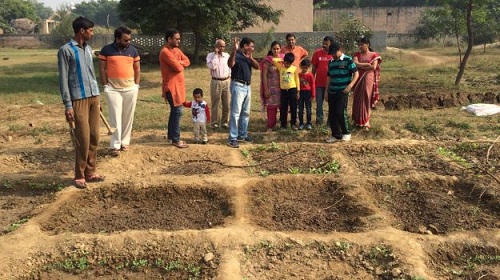
Along with green mulch we use enormous quantity of jeevamrutha. It further lessens the water requirements by the plants and increases the micro-organisms in the right proportion as needed by the soil. As it is known jeevamrutha is prepared from cow dung and cow urine of native cow breeds which is then fermented with jaggery and gram flour. Every evening the farm caretaker sprays jeevamrutha on the plants with foliar spray. After this there is no need for watering the plants. The yield attained was bountiful too. We are able to source cow dung and urine from Ramneesh’s gaushala that he runs for rescued cows.
In every square, we grow five vegetables from five different families. None of the vegetable is repeated in nine squares. To begin with, on the edge of the squares we grow root vegetables, below it we grow plants belonging to brassica family, the third lane is legumes, fourth is green leafy veggies and last vegetable family is nightshade. The same sequence is followed in every square but the vegetables are not repeated. For example in square A1 we will grow beet root, cauliflower, peas, spinach and tomatoes. In the next square we shall have radish, broccoli, chickpea (kala channa), coriander, green chillies. Growing five different vegetables in one square also helps in keeping the soil fertile and keeps it safe from all sorts of insects and pests attack.
As we are not adding any chemicals based farming inputs we wanted the seeds to be indigenous too. Therefore after immense look out, we came in contact with Bangalore based Nimai Garden. The seeds procured from Nimai Garden germinate 90-95%. Reason being they treat seeds with beejamrutha that involves soaking seeds in the liquid mix of cow dung, cow urine, calcium and other essential plant elements that boost up germination probability to 90-95%. Besides we sow the seeds manually ensure the perfect plant-plant distance. For some vegetables like tomato and brinjal we have to make the saplings so we have an in-house nursery to do so. The saplings are prepared in advance so that it can be planted at right time in the squares.
Above all I want to highlight that we grow exclusively seasonal vegetables because we believe in working in harmony with the nature. Our next plan is to expand our farming operations with growing different kinds of millets after receiving abundant production of vegetables. We shall be including rain water harvesting and water channels in the matrix to facilitate the irrigation once in a week. Rest it shall be cow-centric farming.
We do not sell the vegetables commercially because we are farming for passion and not money. Passion is to grow food inspite of various constraints in the farming. We attained bountiful production inspite of having less water and land plus without using any technology or machinery. It certainly is tedious to do farming manually but we were determined to make it through and we were able to do it. It has been a great learning experience for all our families. Worth the try!!
(As told to Shweta Dhanuka)
Contact details:
Nandini Farms
Farm Address: Village Kheri, Bhanota District, Gautam Budha Nagar, Greater Noida West, India
Correspondence Address: ‘Sukoon’ E218, Jalvayu Vihar, Sector 21, Noida, Uttar Pradesh, India
Mobile: 09810571752
Email: Nandinidiesh2@gmail.com
In the present era farming practices needs to move from maximum to minimum in terms of using natural resources precisely water and land. Both are getting scarce with each passing day. Mrs. Nandini Diesh and Mr. Ramneesh developed an upgraded adaptation of squarefoot garden re-designed to suit Indian farming conditions. It is used for growing vegetables organically in the cities. Soon they were joined by four other members Mr. Dinesh Sharma, Mr. Vijay Bhasin, Mr. Rudra Mahapatra and Mr. Amit Rana. All of them are based at Noida, Uttar Pradesh. Ms. Nandini, a corporate lawyer by profession now is passionate farmer as well. She shares details on farming with constraints, seeds, importance of eating seasonal vegetables and future plans. Excerpts:
Mrs. Nandini Diesh
Gone are the days of flood irrigation as now we have to use every single drop of water with utmost care and conscious. Secondly we hardly have open fields left so it has become mandatory to learn to grow food in minimum available space. Farming with these two prime constraints is challenging but not impossible! We found the solution in squarefoot garden. We have used the concept of this model but we have restructured it completely to the requirements of Indian soil.
First step was to identify the right piece of land to grow veggies. All of us together searched for farmland at Khedi Bhanauta village, 25 km from Noida. Land owner Mr. Vikrant Tongad being an environmentalist could understand our goals and objectives behind our farming project hence gave us the land on lease at Rs. 12 thousand per year.
In our model of farming, we have created a matrix of 3*3 square pits. Each square is dug in the dimension of 1.5m(l)*1.5m(b)*8 inches(deep). In the center of the square there is thick green mulch/compost made from green garden waste. The mulch provides all the nutrients to the crops grown in the square and enhances the humus in the soil. It also holds the rainwater and manually poured water naturally. Consequently the moisture is retained well in the soil that drastically reduces the water requirements. We water our field only once in a month. We keep adding mulch in the squares as and when needed. We had 9 such matrix all over the farm.
Along with green mulch we use enormous quantity of jeevamrutha. It further lessens the water requirements by the plants and increases the micro-organisms in the right proportion as needed by the soil. As it is known jeevamrutha is prepared from cow dung and cow urine of native cow breeds which is then fermented with jaggery and gram flour. Every evening the farm caretaker sprays jeevamrutha on the plants with foliar spray. After this there is no need for watering the plants. The yield attained was bountiful too. We are able to source cow dung and urine from Ramneesh’s gaushala that he runs for rescued cows.
In every square, we grow five vegetables from five different families. None of the vegetable is repeated in nine squares. To begin with, on the edge of the squares we grow root vegetables, below it we grow plants belonging to brassica family, the third lane is legumes, fourth is green leafy veggies and last vegetable family is nightshade. The same sequence is followed in every square but the vegetables are not repeated. For example in square A1 we will grow beet root, cauliflower, peas, spinach and tomatoes. In the next square we shall have radish, broccoli, chickpea (kala channa), coriander, green chillies. Growing five different vegetables in one square also helps in keeping the soil fertile and keeps it safe from all sorts of insects and pests attack.
As we are not adding any chemicals based farming inputs we wanted the seeds to be indigenous too. Therefore after immense look out, we came in contact with Bangalore based Nimai Garden. The seeds procured from Nimai Garden germinate 90-95%. Reason being they treat seeds with beejamrutha that involves soaking seeds in the liquid mix of cow dung, cow urine, calcium and other essential plant elements that boost up germination probability to 90-95%. Besides we sow the seeds manually ensure the perfect plant-plant distance. For some vegetables like tomato and brinjal we have to make the saplings so we have an in-house nursery to do so. The saplings are prepared in advance so that it can be planted at right time in the squares.
Above all I want to highlight that we grow exclusively seasonal vegetables because we believe in working in harmony with the nature. Our next plan is to expand our farming operations with growing different kinds of millets after receiving abundant production of vegetables. We shall be including rain water harvesting and water channels in the matrix to facilitate the irrigation once in a week. Rest it shall be cow-centric farming.
We do not sell the vegetables commercially because we are farming for passion and not money. Passion is to grow food inspite of various constraints in the farming. We attained bountiful production inspite of having less water and land plus without using any technology or machinery. It certainly is tedious to do farming manually but we were determined to make it through and we were able to do it. It has been a great learning experience for all our families. Worth the try!!
(As told to Shweta Dhanuka)
Contact details:
Nandini Farms
Farm Address: Village Kheri, Bhanota District, Gautam Budha Nagar, Greater Noida West, India
Correspondence Address: ‘Sukoon’ E218, Jalvayu Vihar, Sector 21, Noida, Uttar Pradesh, India
Mobile: 09810571752
Email: Nandinidiesh2@gmail.com
Last edited: