

Dr. Rajinder Chaudhary
Training organic farmers
Dr Rajinder Chaudhary, Former Professor, Department of Economics, M D University, Rohtak and currently Advisor, Kudarti Kheti Abhiyan, Haryana, talks about his experience in training and promoting self-reliant organic farming. Self-reliant organic farming is based on locally available inputs. It uses materials that are available on the farm or in its surroundings. It stops usage of chemical fertilisers and pesticides, relying instead on compost, changes in agronomic practices and biological methods. This type of farming improves soil fertility and farm profitability along with protecting the environment. It supports sustainable and healthy food production.
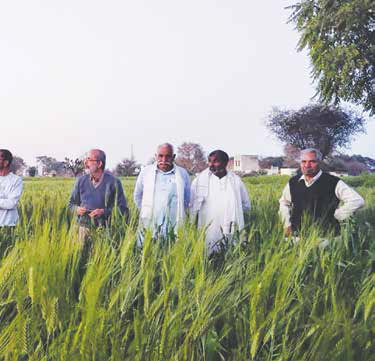
Kudarti Kheti Abhiyan, Haryana, is an unregistered informal group working for promoting self-reliant organic farming in Haryana since 2009. We have observed that people who come to organic farming come for various reasons and for various purposes. Some come for health reasons. Some, for whom their main profession is not farming, are doing it mainly for health reasons. Some of them may also be active commercially but they are not dependent on farming completely. But Abhiyan has been basically working with those farmers who are surviving on farming. So that is the perspective with which we have been working for so many years and it is from that vantage point that I speak.
Since ours is a voluntary group without any funding, we were not in a position to offer any financial or marketing support to them. As we were not able to provide any marketing support or provide any financial help, targeting equivalent yield was our goal from day one. A farmer who is surviving on agriculture solely and not getting any marketing or financial support, will shift to organic farming only if it promises to increase their income. And without any marketing support, to make organic farming profitable, they have to target an equivalent yield. That was one cornerstone of our strategy.
The second aspect was that it had to be self-reliant farming. As we were providing training to the farmers who were spread all over Haryana, so we could not provide any other inputs either. While this aspect was mandated by our situation, yet it was also a conscious choice. Focus on self-reliant farming is also essential from the Gandhian perspective of self-reliant villages; self-reliant villages are not possible without self-reliant farming. So, this perspective was chosen.
Now, the first thing we learnt was that people usually think that to do organic farming the only thing that they have to do is to stop usage of chemicals. But stopping chemical use is only a minimum essential requirement. To conflate organic farming with the stoppage of use of chemicals is a very narrow perspective of organic farming. If we want to have a good yield, equivalent to or even better than chemical farming, then we cannot just stop at using chemicals but otherwise continue farming as usual. That way you do not get good yield.. But initially for many years Haryana farmers also adopted this narrow vision of organic farming and we did not get good yield.
In our training program for the farmers, we would mention all kinds of changes, but the farmers would practically follow only the suggestion of stopping the use of chemicals, while their other agronomic practices would continue as they were. As a result, we were not getting good results. Though for some crops, the yields were comparable from day one but for wheat, which is the main or benchmark crop for Haryana, the yield was not comparable. In the course of time, slowly and steadily, we learnt that organic farming is much more than simply stopping the use of chemicals.
Different organic farming perspectives
Non-chemical farming or alternative farming is known by various names. There are various promoters and trainers who lay emphasis on different methods of non-chemical farming. We call ourselves Kudarti Kheti Abhiyan, Haryana, which in English would mean Natural Farming Campaign. But we also call the kind of farming we promote as self-reliant organic farming. To our mind, self-reliant organic farming, which means not being dependent on external inputs, and natural farming are one and the same thing. Moreover, whichever name may be used, if we go into the details, around 90 to 95 per cent of what all promoters and trainers are suggesting is essentially the same. In a few methods or techniques, maybe two to five per cent, there may be differences.
What's wrong with the chemically grown conventional food
Many consumers are aware of the residue problem, i.e., chemicals used in farming end up on our food table because food that we eat carries chemicals used on farms. I also initially knew only that much. But in due course, I realised that even if the residue problem is taken care of and even if there are no chemical residues in the food, conventional food is lacking nutrition as overtime nutritional composition of food has deteriorated.
The National Institute of Nutrition in Hyderabad, and similar bodies in Britain, the USA, and elsewhere in the world, every decade or two undertake nutritional analysis of the food being consumed. In India, the data is available from the 1930s onwards. This data is available in the public domain. The surprising and worrying point is that it shows that the nutritional composition of food is steadily going down. Oranges that we consume do not have the kind of vitamin C that oranges had in our grandmother’s time. Carrots do not have the kind of vitamin A that they had in earlier times. And maybe our future generation will face an even worse situation if things continue in the same way.
Part of the reason for the decline in nutritional composition of food may be in the choice of seeds developed but it is not unrelated to unbalanced nutrition which crops are getting. Of the 34 identified nutrients that plants have, chemical farming mainly relies on providing NPK (Nitrogen, Phosphorous and Potash) with Zink and such like few other inputs added once in a while. With plants themselves deprived of balanced nutrition, how can their produce provide all nutrients?
So organic farming, from a consumer’s perspective, is not just about getting rid of harmful residues. Organic farming also gives consumers more nutritious food. This is something I learned after I started working for organic agriculture. So, it does not surprise me now to see that these days we have so many food supplements, fortified foods, with governments even trying to make fortification compulsory. Food supplements and fortification is needed because food lacks nutrition.
If we are choosing to do organic farming primarily for health reasons, for better nutrition, and not looking at it as an economic endeavour, then maybe we can continue with the narrow vision of organic farming, stopping chemicals and letting nature do whatever is possible. But if you are surviving on agriculture and doing organic farming for that purpose, then you need to get good yield also and to get that you have to change many other agronomical practices too.
Agronomic changes needed for self-reliant but high yielding organic agriculture
It does not require complicated changes, but many simple changes have to be undertaken consciously. Only then will the yield be comparable. For self-reliant organic farming to be high yielding, one has to forgo narrow vision of organic farming and move to a broader, holistic vision of organic farming. To give a few points to differentiate the two, holistic organic farming cannot be monoculture. It cannot be single-crop-based, except maybe for paddy. Even in paddy, experienced organic farmers do not grow only paddy. They grow other crops alongside in the same field. In Haryana, except for paddy, we say it should be mixed, and multiple cropping. Different crops support each other in various ways, whether it is through soil nutrients, pest management, managing market uncertainty or weather unpredictability.
Secondly, farmyard manure or compost has to be used. But at least in Haryana, and I am sure it may be so in other parts of the country too, the traditional method of using cow dung as a soil booster is not correct. Traditionally, when farmers pick up farmyard manure for transporting it into the field, it is hot. They say it burns their feet. If it is hot, then it is not properly composted. It is undecomposed cow dung that is being used. But by adopting a few simple steps good compost can be made from cow dung. It is more a matter of knowledge than a matter of money or fancy inputs.
Another simple change is the way we irrigate our fields. In Haryana, generally, agricultural farms get electricity only at night. Every day, a farmer cannot keep awake and irrigate his or her fields. What has evolved is that farmers have plots, sometimes one acre, sometimes two or three acres long. At night, the tube well is switched on, and water continues to flow from one end of the long plot to the other end for a few hours. In chemical farming, maybe no immediate harm is done because the soil is already dead without microorganisms. But for organic farming, we stop using chemicals so that soil microorganisms develop and then drowning the same microorganisms by flood irrigation over large plots is counterproductive. This was something we learned the hard way.
Though we mentioned these things in our training and booklets/pamphlets, but initially we did not emphasise many of these aspects strongly enough. Anyway, farmers were not convinced of the desirability or feasibility of these changes. They questioned mixed cropping, small plot irrigation, and other agronomic changes. For them, stopping chemicals was the end of organic farming. Yields were not improving. Then we organised exposure visits to Maharashtra and Gujarat. These were self-financed visits. Farmers paid from their own pockets. They saw healthy crops, good yields, and mixed cropping being practised successfully. Then, they realised that it was both desirable and feasible. They started adopting these practices slowly on their own farms. Yields improved significantly in just two years. In 2021, after the peak coronavirus period was over, we held a widely attended public hearing based on our telephonic survey data. Before that, in 2019, we had a mix of face-to-face meetings and telephonic interviews. Wheat was chosen as the benchmark crop because it is the most important crop in Haryana and also the most problematic under organic farming. To our surprise, of 98 farmers for which wheat yield data was available (out of 283 surveyed in 2020), 45 (about 46 per cent) were getting better than the state average yield (as per publicly available Haryana government data) in wheat. As statistically, only about 50 per cent observations can be above average, so this was a significant result. This clearly established that organic farming, besides giving more nutritious food, can give comparable yield too.
Stopping chemicals is the easier part. Changing various other agronomic practices is the real task. So we suggest to farmers that they should not convert their entire landholding in one go. They should convert a small portion, adopt all recommended organic practices, achieve comparable yield, and then gradually expand. Another learning is that farmers should begin with crops, seeds, and varieties they are familiar with. Crops/seeds will change over time, but familiarity helps during initial transition.
Another important learning was that farmers often look for silver bullet solutions. Someone promotes a decomposer, someone promotes jeevamrut, someone promotes some other formulation. But the harsh truth is that there are no silver bullet solutions. There are broad principles that are almost universally valid, but methods must be location-specific, farmer situation specific. Farmers must innovate and learn by doing. For example, practices developed in South/Central India, from where we learnt a lot, had to be adapted to North Indian conditions. In the South, cows are still common, while in the North, buffalo are more common. Coconut-based inputs do not work in the North. Gliricidia is used for biomass generation in the South but it does not grow well in Haryana. So, understanding principles and adapting methods as per local situation is essential.
Organic farming also requires advance planning. In chemical farming, you just need money in your pocket as inputs and equipment are available almost everywhere and at any time. In organic farming, inputs-tools or seeds may not be readily available. For example, non-BT cotton seeds are hard to find and require advance planning for procurment. Organic farming also requires continuous attention of farmer because of mixed cropping and staggered harvesting. It is not suitable for absentee farmers. Moreover, one-time training is not sufficient. Long handholding is needed. Farmer interaction and exposure visits are the most effective tools, and learning from other farmers is extremely powerful. This is how our movement progressed in Haryana.
Some more about principles and methods
Chemical-free farming is the need of the hour for health, the environment, and employment. Organic farming uses more labour, which is beneficial in a country with high unemployment. Self-reliant organic farming can help realise Mahatma Gandhi’s vision of self-reliant villages. Soil fertility in organic farming is managed by recycling biomass, proper composting, green manuring, mixed cropping, and increasing soil microorganisms. We have enough cattle to give the required amount of compost but we need to improve the method of composting. Green manure, whenever possible, should be applied within 30 to 40 days after sowing, before seed formation. The four important things that are essential for organic farming are recycling biomass, composting properly, and using mixed green manuring and mixed/diverse cropping. There should not be any monoculture. Initially, soils are biologically dead without any microorganisms, and so stopping chemicals and introducing microbial life through jeevamrit or some such formulation is crucial. Pest and disease management improve as soil health improves. Mixed cropping disrupts pest cycles. Many insects are beneficial. Fungal diseases can be controlled using sour buttermilk. Seed treatment using organic methods prevents many problems. If required, biomass-based pest repellents can be prepared at home.
Weed management remains a technical challenge in organic farming as no safe botanical sprays have emerged as yet. If agronomic practices do not suffice and weeds become a menace, then manual removal is the only alternative. But this can be quite costly. Non-technical challenges include lower financial and social status of farmer as compared to other professions. Small farmers struggle to compete socially with other professions. This explains the lack of interest of youth in farming.
Government support deficit
Government policies have not effectively supported and promoted organic farming despite frequent announcements and in spite of positive official research data. The ICAR Institute of Farming Systems Research, Modipuram has been conducting comparative trials since 2004 in 16 states and 20 centres. These comparative trials show better yields under organic farming after initial years, yet policy support remains limited. The recommendations to allot 50% of the land of research institutes for organic farming have not been implemented so far. Agricultural scientists, given their long years of training focused on chemical farming, find it difficult to work with non-chemical methods. Hence, on ground, not much is being done by the government for organic farming. Moreover, recent policy interventions have sought to derive a wedge between organic and natural farming. With natural farming having separate standards and certification regimes, it is causing confusion among consumers as well as agricultural scientists and officials. .
Guidance for new farmers
Advice to new organic farmers differs as per background. Urban/first time farmers should partner with experienced chemical farmers for some time, as they may not know much about farming as such, e.g., crops suitable to their soil and situation. Anyone wanting to practise organic farming should have basic knowledge of farming as well as that of organic farming methods/alternatives and principles. Chemical farmers should start small but must plan to persist for two to three years. Even if initially they do not get good results, they must continue to learn from other organic farmers and not conclude on the basis of single crop season results.
Organic farming principles apply across regions, but methods have to be adopted to local conditions. Government support remains limited, and confusion between organic and natural farming is creating more problems. Certification processes are complex and difficult for small farmers. Despite challenges, organic farming is gaining momentum. Social change is slow, but local models, farmer-led initiatives, and exposure visits are driving progress.
Success stories include farmers expanding organic farming without financial or marketing support, proving profitability. A large number of farmers have converted entire landholdings. One farmer with three acres leased additional land and converted it successfully in the first year itself. Many farmers visit his farm on the last Sunday of every month to learn from him.
If organic farming is possible in Haryana, in the heart of the so-called ‘Green Revolution’ area, it implies it is possible anywhere. Organic farming should not be limited to niche areas or crops. If we want safe food, environmental protection, and better health, intensively farmed areas must also convert. Our experience shows this is possible.
Contact details
Dr. Rajinder Chaudhary, Former Professor of Economics, MD University, Rohtak (Haryana)
Advisor, Kudarti Kheti Abhiyan, Haryana
M: 9416182061
E: rajinderc@gmail.com
Training organic farmers
Dr Rajinder Chaudhary, Former Professor, Department of Economics, M D University, Rohtak and currently Advisor, Kudarti Kheti Abhiyan, Haryana, talks about his experience in training and promoting self-reliant organic farming. Self-reliant organic farming is based on locally available inputs. It uses materials that are available on the farm or in its surroundings. It stops usage of chemical fertilisers and pesticides, relying instead on compost, changes in agronomic practices and biological methods. This type of farming improves soil fertility and farm profitability along with protecting the environment. It supports sustainable and healthy food production.
Kudarti Kheti Abhiyan, Haryana, is an unregistered informal group working for promoting self-reliant organic farming in Haryana since 2009. We have observed that people who come to organic farming come for various reasons and for various purposes. Some come for health reasons. Some, for whom their main profession is not farming, are doing it mainly for health reasons. Some of them may also be active commercially but they are not dependent on farming completely. But Abhiyan has been basically working with those farmers who are surviving on farming. So that is the perspective with which we have been working for so many years and it is from that vantage point that I speak.
Since ours is a voluntary group without any funding, we were not in a position to offer any financial or marketing support to them. As we were not able to provide any marketing support or provide any financial help, targeting equivalent yield was our goal from day one. A farmer who is surviving on agriculture solely and not getting any marketing or financial support, will shift to organic farming only if it promises to increase their income. And without any marketing support, to make organic farming profitable, they have to target an equivalent yield. That was one cornerstone of our strategy.
The second aspect was that it had to be self-reliant farming. As we were providing training to the farmers who were spread all over Haryana, so we could not provide any other inputs either. While this aspect was mandated by our situation, yet it was also a conscious choice. Focus on self-reliant farming is also essential from the Gandhian perspective of self-reliant villages; self-reliant villages are not possible without self-reliant farming. So, this perspective was chosen.
Now, the first thing we learnt was that people usually think that to do organic farming the only thing that they have to do is to stop usage of chemicals. But stopping chemical use is only a minimum essential requirement. To conflate organic farming with the stoppage of use of chemicals is a very narrow perspective of organic farming. If we want to have a good yield, equivalent to or even better than chemical farming, then we cannot just stop at using chemicals but otherwise continue farming as usual. That way you do not get good yield.. But initially for many years Haryana farmers also adopted this narrow vision of organic farming and we did not get good yield.
In our training program for the farmers, we would mention all kinds of changes, but the farmers would practically follow only the suggestion of stopping the use of chemicals, while their other agronomic practices would continue as they were. As a result, we were not getting good results. Though for some crops, the yields were comparable from day one but for wheat, which is the main or benchmark crop for Haryana, the yield was not comparable. In the course of time, slowly and steadily, we learnt that organic farming is much more than simply stopping the use of chemicals.
Different organic farming perspectives
Non-chemical farming or alternative farming is known by various names. There are various promoters and trainers who lay emphasis on different methods of non-chemical farming. We call ourselves Kudarti Kheti Abhiyan, Haryana, which in English would mean Natural Farming Campaign. But we also call the kind of farming we promote as self-reliant organic farming. To our mind, self-reliant organic farming, which means not being dependent on external inputs, and natural farming are one and the same thing. Moreover, whichever name may be used, if we go into the details, around 90 to 95 per cent of what all promoters and trainers are suggesting is essentially the same. In a few methods or techniques, maybe two to five per cent, there may be differences.
What's wrong with the chemically grown conventional food
Many consumers are aware of the residue problem, i.e., chemicals used in farming end up on our food table because food that we eat carries chemicals used on farms. I also initially knew only that much. But in due course, I realised that even if the residue problem is taken care of and even if there are no chemical residues in the food, conventional food is lacking nutrition as overtime nutritional composition of food has deteriorated.
The National Institute of Nutrition in Hyderabad, and similar bodies in Britain, the USA, and elsewhere in the world, every decade or two undertake nutritional analysis of the food being consumed. In India, the data is available from the 1930s onwards. This data is available in the public domain. The surprising and worrying point is that it shows that the nutritional composition of food is steadily going down. Oranges that we consume do not have the kind of vitamin C that oranges had in our grandmother’s time. Carrots do not have the kind of vitamin A that they had in earlier times. And maybe our future generation will face an even worse situation if things continue in the same way.
Part of the reason for the decline in nutritional composition of food may be in the choice of seeds developed but it is not unrelated to unbalanced nutrition which crops are getting. Of the 34 identified nutrients that plants have, chemical farming mainly relies on providing NPK (Nitrogen, Phosphorous and Potash) with Zink and such like few other inputs added once in a while. With plants themselves deprived of balanced nutrition, how can their produce provide all nutrients?
So organic farming, from a consumer’s perspective, is not just about getting rid of harmful residues. Organic farming also gives consumers more nutritious food. This is something I learned after I started working for organic agriculture. So, it does not surprise me now to see that these days we have so many food supplements, fortified foods, with governments even trying to make fortification compulsory. Food supplements and fortification is needed because food lacks nutrition.
If we are choosing to do organic farming primarily for health reasons, for better nutrition, and not looking at it as an economic endeavour, then maybe we can continue with the narrow vision of organic farming, stopping chemicals and letting nature do whatever is possible. But if you are surviving on agriculture and doing organic farming for that purpose, then you need to get good yield also and to get that you have to change many other agronomical practices too.
Agronomic changes needed for self-reliant but high yielding organic agriculture
It does not require complicated changes, but many simple changes have to be undertaken consciously. Only then will the yield be comparable. For self-reliant organic farming to be high yielding, one has to forgo narrow vision of organic farming and move to a broader, holistic vision of organic farming. To give a few points to differentiate the two, holistic organic farming cannot be monoculture. It cannot be single-crop-based, except maybe for paddy. Even in paddy, experienced organic farmers do not grow only paddy. They grow other crops alongside in the same field. In Haryana, except for paddy, we say it should be mixed, and multiple cropping. Different crops support each other in various ways, whether it is through soil nutrients, pest management, managing market uncertainty or weather unpredictability.
Secondly, farmyard manure or compost has to be used. But at least in Haryana, and I am sure it may be so in other parts of the country too, the traditional method of using cow dung as a soil booster is not correct. Traditionally, when farmers pick up farmyard manure for transporting it into the field, it is hot. They say it burns their feet. If it is hot, then it is not properly composted. It is undecomposed cow dung that is being used. But by adopting a few simple steps good compost can be made from cow dung. It is more a matter of knowledge than a matter of money or fancy inputs.
Another simple change is the way we irrigate our fields. In Haryana, generally, agricultural farms get electricity only at night. Every day, a farmer cannot keep awake and irrigate his or her fields. What has evolved is that farmers have plots, sometimes one acre, sometimes two or three acres long. At night, the tube well is switched on, and water continues to flow from one end of the long plot to the other end for a few hours. In chemical farming, maybe no immediate harm is done because the soil is already dead without microorganisms. But for organic farming, we stop using chemicals so that soil microorganisms develop and then drowning the same microorganisms by flood irrigation over large plots is counterproductive. This was something we learned the hard way.
Though we mentioned these things in our training and booklets/pamphlets, but initially we did not emphasise many of these aspects strongly enough. Anyway, farmers were not convinced of the desirability or feasibility of these changes. They questioned mixed cropping, small plot irrigation, and other agronomic changes. For them, stopping chemicals was the end of organic farming. Yields were not improving. Then we organised exposure visits to Maharashtra and Gujarat. These were self-financed visits. Farmers paid from their own pockets. They saw healthy crops, good yields, and mixed cropping being practised successfully. Then, they realised that it was both desirable and feasible. They started adopting these practices slowly on their own farms. Yields improved significantly in just two years. In 2021, after the peak coronavirus period was over, we held a widely attended public hearing based on our telephonic survey data. Before that, in 2019, we had a mix of face-to-face meetings and telephonic interviews. Wheat was chosen as the benchmark crop because it is the most important crop in Haryana and also the most problematic under organic farming. To our surprise, of 98 farmers for which wheat yield data was available (out of 283 surveyed in 2020), 45 (about 46 per cent) were getting better than the state average yield (as per publicly available Haryana government data) in wheat. As statistically, only about 50 per cent observations can be above average, so this was a significant result. This clearly established that organic farming, besides giving more nutritious food, can give comparable yield too.
Stopping chemicals is the easier part. Changing various other agronomic practices is the real task. So we suggest to farmers that they should not convert their entire landholding in one go. They should convert a small portion, adopt all recommended organic practices, achieve comparable yield, and then gradually expand. Another learning is that farmers should begin with crops, seeds, and varieties they are familiar with. Crops/seeds will change over time, but familiarity helps during initial transition.
Another important learning was that farmers often look for silver bullet solutions. Someone promotes a decomposer, someone promotes jeevamrut, someone promotes some other formulation. But the harsh truth is that there are no silver bullet solutions. There are broad principles that are almost universally valid, but methods must be location-specific, farmer situation specific. Farmers must innovate and learn by doing. For example, practices developed in South/Central India, from where we learnt a lot, had to be adapted to North Indian conditions. In the South, cows are still common, while in the North, buffalo are more common. Coconut-based inputs do not work in the North. Gliricidia is used for biomass generation in the South but it does not grow well in Haryana. So, understanding principles and adapting methods as per local situation is essential.
Organic farming also requires advance planning. In chemical farming, you just need money in your pocket as inputs and equipment are available almost everywhere and at any time. In organic farming, inputs-tools or seeds may not be readily available. For example, non-BT cotton seeds are hard to find and require advance planning for procurment. Organic farming also requires continuous attention of farmer because of mixed cropping and staggered harvesting. It is not suitable for absentee farmers. Moreover, one-time training is not sufficient. Long handholding is needed. Farmer interaction and exposure visits are the most effective tools, and learning from other farmers is extremely powerful. This is how our movement progressed in Haryana.
Some more about principles and methods
Chemical-free farming is the need of the hour for health, the environment, and employment. Organic farming uses more labour, which is beneficial in a country with high unemployment. Self-reliant organic farming can help realise Mahatma Gandhi’s vision of self-reliant villages. Soil fertility in organic farming is managed by recycling biomass, proper composting, green manuring, mixed cropping, and increasing soil microorganisms. We have enough cattle to give the required amount of compost but we need to improve the method of composting. Green manure, whenever possible, should be applied within 30 to 40 days after sowing, before seed formation. The four important things that are essential for organic farming are recycling biomass, composting properly, and using mixed green manuring and mixed/diverse cropping. There should not be any monoculture. Initially, soils are biologically dead without any microorganisms, and so stopping chemicals and introducing microbial life through jeevamrit or some such formulation is crucial. Pest and disease management improve as soil health improves. Mixed cropping disrupts pest cycles. Many insects are beneficial. Fungal diseases can be controlled using sour buttermilk. Seed treatment using organic methods prevents many problems. If required, biomass-based pest repellents can be prepared at home.
Weed management remains a technical challenge in organic farming as no safe botanical sprays have emerged as yet. If agronomic practices do not suffice and weeds become a menace, then manual removal is the only alternative. But this can be quite costly. Non-technical challenges include lower financial and social status of farmer as compared to other professions. Small farmers struggle to compete socially with other professions. This explains the lack of interest of youth in farming.
Government support deficit
Government policies have not effectively supported and promoted organic farming despite frequent announcements and in spite of positive official research data. The ICAR Institute of Farming Systems Research, Modipuram has been conducting comparative trials since 2004 in 16 states and 20 centres. These comparative trials show better yields under organic farming after initial years, yet policy support remains limited. The recommendations to allot 50% of the land of research institutes for organic farming have not been implemented so far. Agricultural scientists, given their long years of training focused on chemical farming, find it difficult to work with non-chemical methods. Hence, on ground, not much is being done by the government for organic farming. Moreover, recent policy interventions have sought to derive a wedge between organic and natural farming. With natural farming having separate standards and certification regimes, it is causing confusion among consumers as well as agricultural scientists and officials. .
Guidance for new farmers
Advice to new organic farmers differs as per background. Urban/first time farmers should partner with experienced chemical farmers for some time, as they may not know much about farming as such, e.g., crops suitable to their soil and situation. Anyone wanting to practise organic farming should have basic knowledge of farming as well as that of organic farming methods/alternatives and principles. Chemical farmers should start small but must plan to persist for two to three years. Even if initially they do not get good results, they must continue to learn from other organic farmers and not conclude on the basis of single crop season results.
Organic farming principles apply across regions, but methods have to be adopted to local conditions. Government support remains limited, and confusion between organic and natural farming is creating more problems. Certification processes are complex and difficult for small farmers. Despite challenges, organic farming is gaining momentum. Social change is slow, but local models, farmer-led initiatives, and exposure visits are driving progress.
Success stories include farmers expanding organic farming without financial or marketing support, proving profitability. A large number of farmers have converted entire landholdings. One farmer with three acres leased additional land and converted it successfully in the first year itself. Many farmers visit his farm on the last Sunday of every month to learn from him.
If organic farming is possible in Haryana, in the heart of the so-called ‘Green Revolution’ area, it implies it is possible anywhere. Organic farming should not be limited to niche areas or crops. If we want safe food, environmental protection, and better health, intensively farmed areas must also convert. Our experience shows this is possible.
Contact details
Dr. Rajinder Chaudhary, Former Professor of Economics, MD University, Rohtak (Haryana)
Advisor, Kudarti Kheti Abhiyan, Haryana
M: 9416182061
E: rajinderc@gmail.com