
Taxus baccata seedlings
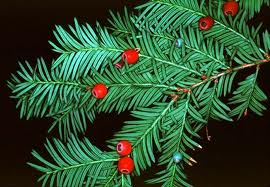 Taxus baccata
Sub sp. walliciana (Zucc.) Pilger.
Family: Taxaceae (Taxus baccata Family)
Common name: Himalayan Yew
Urdu name : Zarnab
Cashmerian name: Taxus
Arabic name : Talisfar
Bengali name : Birmi, Talish Patra, Bhada Getela
Chinese name : Tzu shan
English name : Yew, Common Yew, Chinwood
French name : If commun
German name : Eibe, Eife, Ibenbaum, Kantelbaum, Taxbaum, Ybe
Gujarati name : Gethela Barmi
Hindi name : Talispatr, Talis Patta
Kannada name : Sthauneyak
Marathi name : Sthauney Barmi
Persian name : Zarnab
Punjabi name : Birmi
Sanskrit name : Mandhuparni, Talispatra, Sukapuspa
Habitat : Forests, shady ravines above 3000 m
Distribution : Afghanistan, Kashmir, IRAN, Pakistan, China, burma, S.E. Asia
Medicinal use of Taxus baccata : The Taxus baccata tree is a highly toxic plant that has occasionally been used medicinally, mainly in the treatment of chest complaints. Modern research has shown that the plants contain the substance "taxol" in their shoots. Taxol has shown exciting potential as an anti-cancer drug, particularly in the treatment of ovarian cancers. Unfortunately, the concentrations of taxol in this species are too low to be of much value commercially, though it is being used for research purposes. This remedy should be used with great caution and only under the supervision of a qualified practitioner. See also the notes above on toxicity. All parts of the plant, except the fleshy fruit, are antispasmodic, cardiotonic, diaphoretic, emmenagogue, expectorant, narcotic and purgative. The leaves have been used internally in the treatment of asthma, bronchitis, hiccup, indigestion, rheumatism and epilepsy. Externally, the leaves have been used in a steam bath as a treatment for rheumatism. A homeopathic remedy is made from the young shoots and the berries. It is used in the treatment of many diseases including cystitis, eruptions, headaches, heart and kidney problems, rheumatism etc.
It is also used in treatment of asthma, bronchitis, rheumatism, high fever, indigestion, haemoptysis and epilepsy. In 1021, Avicenna, also known as Ibn Sina, introduced the medicinal use of Taxus baccata L for phytotherapy in The Canon of Medicine . He named this herbal drug as “Zarnab” and used it as a cardiac remedy. It is the first known use of a calcium channel blocker drug. Externally, used in the treatment of rheumatism.
Description of the plant : Plant: Evergreen Tree
Height: 15 m (49 feet)
Flovering : March to April
Habitat of the herb : Woods and scrub, usually on limestone. It sometimes forms pure stands in sheltered sites on chalk in the south-east and on limestone in the north-west.
Edible parts of Taxus baccata : Fruit - raw. Very sweet and gelatinous, most people find it delicious though some find it sickly. A number of people who like the flavour do not like the texture which is often described as being "snotty". All other parts of this plant, including the seed, are highly poisonous. When eating the fruit you should spit out the large seed found in the fruit's centre. Should you swallow the whole seed it will just pass straight through you without harm. If it is bitten into, however, you will notice a very bitter flavour and the seed should immediately be spat out or it could cause some problems. The fruit is a fleshy berry about 10mm in diameter and containing a single seed. Some reports suggest using the bark as a tea substitute, this would probably be very unwise.
Other uses of the herb : Very tolerant of trimming, this plant makes an excellent hedge. The plants are often used in topiary and even when fairly old, the trees can be cut back into old wood and will resprout. One report says that trees up to 1000 years old respond well to trimming. A decoction of the leaves is used as an insecticide. Some cultivars can be grown as a ground cover when planted about 1 metre or more apart each way. "Repandens" has been recommended. Wood - heavy, hard, durable, elastic, takes a good polish but requires long seasoning. Highly esteemed by cabinet makers, it is also used for bows, tool handles etc. It makes a good firewood. The wood is burnt as an incense.
Taxus baccata seedlings and plants are available at:
Jammu and Kashmir Medicinal Plants Introduction Centre
"Ginkgo House,Azizabad, Nambalbal, (Via Wuyan-Meej Road), Pampore PPR JK 192121
Ph: 01933-223705
Mob: 09858986794
e-mail:jkmpic@gmail.com
home: http://jkmpic.blogspot.com
Sub sp. walliciana (Zucc.) Pilger.
Family: Taxaceae (Taxus baccata Family)
Common name: Himalayan Yew
Urdu name : Zarnab
Cashmerian name: Taxus
Arabic name : Talisfar
Bengali name : Birmi, Talish Patra, Bhada Getela
Chinese name : Tzu shan
English name : Yew, Common Yew, Chinwood
French name : If commun
German name : Eibe, Eife, Ibenbaum, Kantelbaum, Taxbaum, Ybe
Gujarati name : Gethela Barmi
Hindi name : Talispatr, Talis Patta
Kannada name : Sthauneyak
Marathi name : Sthauney Barmi
Persian name : Zarnab
Punjabi name : Birmi
Sanskrit name : Mandhuparni, Talispatra, Sukapuspa
Habitat : Forests, shady ravines above 3000 m
Distribution : Afghanistan, Kashmir, IRAN, Pakistan, China, burma, S.E. Asia
Medicinal use of Taxus baccata : The Taxus baccata tree is a highly toxic plant that has occasionally been used medicinally, mainly in the treatment of chest complaints. Modern research has shown that the plants contain the substance "taxol" in their shoots. Taxol has shown exciting potential as an anti-cancer drug, particularly in the treatment of ovarian cancers. Unfortunately, the concentrations of taxol in this species are too low to be of much value commercially, though it is being used for research purposes. This remedy should be used with great caution and only under the supervision of a qualified practitioner. See also the notes above on toxicity. All parts of the plant, except the fleshy fruit, are antispasmodic, cardiotonic, diaphoretic, emmenagogue, expectorant, narcotic and purgative. The leaves have been used internally in the treatment of asthma, bronchitis, hiccup, indigestion, rheumatism and epilepsy. Externally, the leaves have been used in a steam bath as a treatment for rheumatism. A homeopathic remedy is made from the young shoots and the berries. It is used in the treatment of many diseases including cystitis, eruptions, headaches, heart and kidney problems, rheumatism etc.
It is also used in treatment of asthma, bronchitis, rheumatism, high fever, indigestion, haemoptysis and epilepsy. In 1021, Avicenna, also known as Ibn Sina, introduced the medicinal use of Taxus baccata L for phytotherapy in The Canon of Medicine . He named this herbal drug as “Zarnab” and used it as a cardiac remedy. It is the first known use of a calcium channel blocker drug. Externally, used in the treatment of rheumatism.
Description of the plant : Plant: Evergreen Tree
Height: 15 m (49 feet)
Flovering : March to April
Habitat of the herb : Woods and scrub, usually on limestone. It sometimes forms pure stands in sheltered sites on chalk in the south-east and on limestone in the north-west.
Edible parts of Taxus baccata : Fruit - raw. Very sweet and gelatinous, most people find it delicious though some find it sickly. A number of people who like the flavour do not like the texture which is often described as being "snotty". All other parts of this plant, including the seed, are highly poisonous. When eating the fruit you should spit out the large seed found in the fruit's centre. Should you swallow the whole seed it will just pass straight through you without harm. If it is bitten into, however, you will notice a very bitter flavour and the seed should immediately be spat out or it could cause some problems. The fruit is a fleshy berry about 10mm in diameter and containing a single seed. Some reports suggest using the bark as a tea substitute, this would probably be very unwise.
Other uses of the herb : Very tolerant of trimming, this plant makes an excellent hedge. The plants are often used in topiary and even when fairly old, the trees can be cut back into old wood and will resprout. One report says that trees up to 1000 years old respond well to trimming. A decoction of the leaves is used as an insecticide. Some cultivars can be grown as a ground cover when planted about 1 metre or more apart each way. "Repandens" has been recommended. Wood - heavy, hard, durable, elastic, takes a good polish but requires long seasoning. Highly esteemed by cabinet makers, it is also used for bows, tool handles etc. It makes a good firewood. The wood is burnt as an incense.
Taxus baccata seedlings and plants are available at:
Jammu and Kashmir Medicinal Plants Introduction Centre
"Ginkgo House,Azizabad, Nambalbal, (Via Wuyan-Meej Road), Pampore PPR JK 192121
Ph: 01933-223705
Mob: 09858986794
e-mail:jkmpic@gmail.com
home: http://jkmpic.blogspot.com