
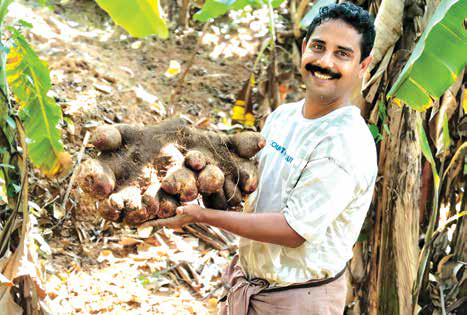
Illiyas K P
Understanding strengths and challenges of organic agriculture
Illiyas K. P, President of the Organic Farming Association of India (OFAI), Shoranur, Kerala, points out how organic agriculture plays a significant role in sustainable agricultural development by promoting environmentally friendly farming practices. It supports long-term soil fertility, biodiversity and farmer well-being. However, organic farming also encounters challenges related to productivity, policy support and consumer awareness. Understanding these strengths and challenges is crucial for the effective implementation and expansion.
I have been practising organic farming in rice and vegetables in my farm of 4 acres, along with cows. Organic farming is the upcoming trend in agriculture, but it has constraints like climate change that affect the crop and soil. Due to the erratic climatic pattern, the UN is also giving much importance to organic cultivation these days. The current concepts about farming are not sustainable, and hence, the shift to organic farming is becoming essential now. The main goal of agriculture is to improve production and consumption. Sustainable farming has various models, such as biodynamic farming, permaculture, natural farming, organic farming, etc., that come with various farming methods also. But the ultimate goal of all these concepts is to do agriculture without chemical fertilisers, pesticides, fungicides and genetically modified seeds. We also have to conserve our water resources.
The total area under organic cultivation for about 20 years was about 11 million hectares, and now it has increased to 76.44 million hectares. When we take into account the subsidy given to fertiliser companies, it is huge compared to the subsidies given to promote organic farming. Sikkim has become a totally organic cultivation state. In Andhra Pradesh, there are various schemes to promote organic farming. Many states have drawn up schemes and policies, but they have not been implemented completely. It was in 2002 that APEDA started focusing on organic farming. We had the National Mission for Sustainable Agriculture, which has come up with various schemes for natural farming. The central government has also started allocating funds for organic farming with a view to helping about 1 crore farmers. We have many NGOs and Organic Farming Association of India that work in various ways to create awareness among the farmers about organic farming and offer training programs.
Constraints of organic farming
Organic farming comes with many challenges. The first one is the funds being invested in organic farming. Even some agricultural universities do not believe in organic farming and claim that it is not scientific. Lots of debates are going on, and studies are being conducted. ICAR studies show that when following organic farming, only a few crops face problems. Many studies establish that farmers get good yields when they adopt organic farming. Only when farmers are assured of good yield and income will they switch over to organic farming. The normal and conventional farmers in India are facing lots of issues, such as crop loss and soil erosion. Though they change the crops and pattern of cultivation, they are still struggling. With the Green Revolution, the government started encouraging the use of fertilisers and machinery. More subsidies were offered for this, and hybrid seeds started entering the markets. Such support is not being given to organic farming. It lacks support. Though farmers are learning a lot through social media about organic farming, manure to apply, how to enrich the soil, and the usage of repellents, there are many issues in the initial stages. The farmers lack awareness about the serious complications of using chemical fertilisers and pesticides, which cause huge health issues. The awareness should be created not only among farmers but also among the public. The farmers should know who will be the target customers for their organic produce, marketability, and price. With lots of issues, the farmers cannot always get time to organise things. They have to pack their produce, go to the market and sell it. So, it is better that we create awareness among people about organic produce and get it from the farmers directly. In Kerala, we have a transparent system of arranging organic markets or outlets. We have to overcome the challenge of bringing the consumer and farmers together.
When we think of organic products, we also think of exporting them to other countries. But we can now export only a few things, like spices, as there is a huge competition. So, competing with big countries will not be sustainable for the farmers. So, they can try to tap the huge potential in India itself. The awareness about the health benefits of organic produce should be highlighted. The policies of the governments are not fully implemented, which affects organic farming. Schemes are needed to help the farmers in packaging, branding, processing, and marketing. We need lots of infrastructure for organic farming. Conventional farming is very easy, as fertilisers and other things are available everywhere. For organic farming, we need jeevamrutam, which can be made in a filtering system, spraying machinery which are totally different from the traditional ones. We need small machinery for tilling. We need to promote a multi-cropping system. There should be processing units for organic produce. The farmers are giving the produce to organic outlets and consumers after processing. People in Kerala prefer rice with bran, which needs a different kind of machinery to remove only the husk and retain the bran. We need to have more of these machinery to help reduce the transportation charges for the farmers. So all these processing procedures involve money, and therefore the price of the organic produce is higher than that of the regular ones, which may not be affordable for the consumers. Mills with a rubberised roller system will help in processing at an affordable price to the consumers.
The scenario remains the same for processing dal and millets to remove the husk and bran. We need the supporting system for this, along with technology. With more importance needed for branding and certification, the Organic Farming Association of India has come up with FPOs in various states to help them in branding, packaging, and marketing. We are organising a farmers' market with the help of APEDA, arranging B2B business with different kinds of traders, etc. With a subsidy, they can sell their produce, and they can observe how the big traders are working on branding, packaging, advertising, and marketing.
The next major thing is certification. When we go for the third-party certification, a lot of money is involved. It will take at least 3 to 4 years to get the certification and third-party certification. The PGS or Participatory Guarantee Scheme is there, which is quite complicated. We have to make the process of getting certification easy for the farmers and reduce the amount farmers have to pay for this. There are tough processes like getting random samples tested. Without certification, marketing also becomes difficult. The whole process should be simplified for the farmers and made transparent. Though the PGS is there, it is not simple, making the marketing aspect tough. We have to build proper markets to help the farmers. The government and companies should come forward to do this. In FPCs, only farmers can be the members and do not have the time or lack the skills to do this. They should be helped in sustainable marketing.
Empowering farmers collectively
These are some of the challenges we are facing. So, we help in organising awareness programs, conventions, training programs and help in conserving traditional seeds for the farmers to use. We also share the knowledge with the farmers in various states. We conduct field visits and organise national organic farming programs. We want farmers to be involved in policy making too, which is not happening due to issues like language, lack of knowledge, skill sets, and not getting the chance. This is the main reason why farmers are not benefited by any policy. The policymaker should understand that the farmers should not just be beneficiaries but should be part of any policymaking or projects. We are getting funding contributions from various sources to use for programs and to be self-sufficient. The organisation should be sustainable to bring in such changes for the farmers. Ours is a voluntary organisation.
When we do organic or natural farming, the yield is almost the same, except for wheat, which reduces marginally. It is a myth that when we get more yield, we get more income. We should focus not only on yield but also on biodiversity. The price we get, even if there is a reduced yield, will be more only in the case of organic products. So, the farmers will get the assured income. Since the organic products are not going to be sold in the conventional market, where nobody will know the value of organic products, there will not be any loss. The organic farmer can build his own market.
Climate-resilient farming practices
The two challenges farmers are facing right now are climate change and attacks by animals. We need to find solutions for this now. We know the traditional way of cultivation and seeds are good. In recent floods in Kerala, we could save some crops because we had used traditional seeds, which could sustain the floods for about two weeks. Odisha is conserving about 1400 seed varieties which can withstand waterlogging for 20 days also. There are some varieties that can withstand drought conditions also. Such traditional seed varieties are important to mitigate climate change. The multi-crop system is very important. Organic farming does not allow chemical fertilisers to be used. We are focusing more on agroecology now. So, we are promoting multi-cropping, such as coconut intercropping with pepper tubers, fruit trees, and ginger or turmeric. In about half an acre of land, we can grow many crops. Every season, there will be some crops ready for marketing. Even if one crop suffers a loss, we can make up for it with the other crops and do the marketing. We do a violet tuber variety, which is quite rare, and people are willing to pay for it. The system can also help in overcoming climate change. We also need to manage the diseases spreading in monocrops like tomatoes. There will be a huge loss if we have a single crop system. So a multi-cropping system will be an ideal and practical solution to manage climatic changes and financial loss.
Organic farming has lots of benefits for the environment, such as soil and water conservation. It is also offering us good, healthy food. About biodiversity conservation, in states like Punjab, we see mostly wheat and rice being cultivated. Earlier, there used to be a good cultivation of millets. This is because of the mono-cropping system. In the case of organic farming, there will be a lot of diversity in different regions, where they can grow different types of crops and animals, and some people even cultivate fish.
Enhancing soil health naturally
While following organic agriculture, we use solutions like Jeevamrutha, Beejamrutham, and Amruthapani which contain microbes to help improve soil health. These are prepared from cow dung. When we apply these and also put mulch, lots of earthworms are produced which improve the water absorption capacity of the soil and makes aeration better. The growth and health of the crop will improve. The soil becomes rich, and after some time, we need not put them in for some time. When we apply chemical fertiliser or compost, the soil becomes very hard, and the pH will decrease, affecting the soil health, and plants may get diseases. The pH should be about 6 to 7, and organic matters make the soil pH normal. Instead of calcium hydroxide generally used, we can use calcium carbonate powder to maintain the soil pH.
Nutrition through organic foods
In Kerala, under the PDS system, white polished rice is preferred by people for their food. It often affects their health. It is because they eat polished rice that does not have any nutrition. So, we are promoting red rice, black rice, and white rice with bran. These are very nutritious varieties. So, people with diabetes can eat the rice with bran, which has been widely experienced. Millets, tubers, leafy vegetables, and fruits grown by organic cultivation have health benefits.
Support for local economies
Sustainable farming had the local economy in focus when it was started. When we buy fertilisers from outside, the money is going to some companies, and the money spent on seeds also goes to some companies. So, about 70% of the money is going outside to other companies for getting fertilisers and seeds. When we turn to organic farming, we can use cow dung for manure, leaves for compost, and traditional seeds for better yield. This will help the local economy. The farmers can help each other by buying grass in exchange for dung, paddy straw as fodder, etc. In this way, we can avoid expenses spent outside.
Organic farming awareness challenge
There is a lack of awareness about this. The farmers should know the type of pests and diseases that the particular crop will be affected by. If they grow chillies, they should know the pest that will attack the plant, when it affects the crop, and how to avoid it. We advise the farmers when they see white flies attacking the crop to cut the leaves and monitor them. It will take at least 2 to 3 years to understand organic farming and the pattern of pest attack. In paddy, we find sucking pests; we can grow plants on the bund that will prevent the spread by applying pesticides. We should know all these preventive measures before starting organic farming. We should be prepared to tackle the situation in the early symptoms rather than applying medicine later, which is not good for organic farming. There are repellent crops like tulsi, corn, and marigold that can be grown in the farm to avoid pest attack.
The economic challenges are there for the farmers in the initial stages. They need funds to have infrastructure such as a processing unit, packing, branding, and certifications. For the consumers, it is the price that is challenging. Organic cultivation should be some support system to help in reducing the price to help common people also get organic produce . The farmers have to sustain. The central government should allocate substantial funds for organic farming, as well as schemes and subsidies. We can grow the locally available vegetables and fruits for nutritional benefits. We should not buy many products from outside. People should know the economic calculations in buying organic products to get nutritional benefits. When they do the calculations, the challenges can be overcome.
The logistical challenges include facts such as the farmers not having proper infrastructure, like roads or transportation facilities. They spend a lot of money on transporting their produce. This increases the cost of the product. In some states, they collect the produce, take it to processing units for packing and send it to market. Such supporting systems are needed.
Transparent farming certifications
The third-party certification is through NPOP, and there are some agencies that do the certification. The private agencies will come to the field, test the soil, and it will take about 2 to 3 years to get the certification. When we want to export the product, the third-party certification has to be done. PGS certification can be done by bringing farmers into groups. The government-approved agency will inspect the products. When the farmers show proof about the seeds they use and the applications, they have to fill in a form and submit it. Checking if any of the farmers are using chemical fertiliser will be a transparent system. The farmers can also apply through the government portals to get the certification.
Contact details
Illiyas K. P
President of the Organic Farming Association of India (OFAI), Shoranur, Kerala
Mobile: 9496149173
Email: presidentofai037@gmail.com
Understanding strengths and challenges of organic agriculture
Illiyas K. P, President of the Organic Farming Association of India (OFAI), Shoranur, Kerala, points out how organic agriculture plays a significant role in sustainable agricultural development by promoting environmentally friendly farming practices. It supports long-term soil fertility, biodiversity and farmer well-being. However, organic farming also encounters challenges related to productivity, policy support and consumer awareness. Understanding these strengths and challenges is crucial for the effective implementation and expansion.
I have been practising organic farming in rice and vegetables in my farm of 4 acres, along with cows. Organic farming is the upcoming trend in agriculture, but it has constraints like climate change that affect the crop and soil. Due to the erratic climatic pattern, the UN is also giving much importance to organic cultivation these days. The current concepts about farming are not sustainable, and hence, the shift to organic farming is becoming essential now. The main goal of agriculture is to improve production and consumption. Sustainable farming has various models, such as biodynamic farming, permaculture, natural farming, organic farming, etc., that come with various farming methods also. But the ultimate goal of all these concepts is to do agriculture without chemical fertilisers, pesticides, fungicides and genetically modified seeds. We also have to conserve our water resources.
The total area under organic cultivation for about 20 years was about 11 million hectares, and now it has increased to 76.44 million hectares. When we take into account the subsidy given to fertiliser companies, it is huge compared to the subsidies given to promote organic farming. Sikkim has become a totally organic cultivation state. In Andhra Pradesh, there are various schemes to promote organic farming. Many states have drawn up schemes and policies, but they have not been implemented completely. It was in 2002 that APEDA started focusing on organic farming. We had the National Mission for Sustainable Agriculture, which has come up with various schemes for natural farming. The central government has also started allocating funds for organic farming with a view to helping about 1 crore farmers. We have many NGOs and Organic Farming Association of India that work in various ways to create awareness among the farmers about organic farming and offer training programs.
Constraints of organic farming
Organic farming comes with many challenges. The first one is the funds being invested in organic farming. Even some agricultural universities do not believe in organic farming and claim that it is not scientific. Lots of debates are going on, and studies are being conducted. ICAR studies show that when following organic farming, only a few crops face problems. Many studies establish that farmers get good yields when they adopt organic farming. Only when farmers are assured of good yield and income will they switch over to organic farming. The normal and conventional farmers in India are facing lots of issues, such as crop loss and soil erosion. Though they change the crops and pattern of cultivation, they are still struggling. With the Green Revolution, the government started encouraging the use of fertilisers and machinery. More subsidies were offered for this, and hybrid seeds started entering the markets. Such support is not being given to organic farming. It lacks support. Though farmers are learning a lot through social media about organic farming, manure to apply, how to enrich the soil, and the usage of repellents, there are many issues in the initial stages. The farmers lack awareness about the serious complications of using chemical fertilisers and pesticides, which cause huge health issues. The awareness should be created not only among farmers but also among the public. The farmers should know who will be the target customers for their organic produce, marketability, and price. With lots of issues, the farmers cannot always get time to organise things. They have to pack their produce, go to the market and sell it. So, it is better that we create awareness among people about organic produce and get it from the farmers directly. In Kerala, we have a transparent system of arranging organic markets or outlets. We have to overcome the challenge of bringing the consumer and farmers together.
When we think of organic products, we also think of exporting them to other countries. But we can now export only a few things, like spices, as there is a huge competition. So, competing with big countries will not be sustainable for the farmers. So, they can try to tap the huge potential in India itself. The awareness about the health benefits of organic produce should be highlighted. The policies of the governments are not fully implemented, which affects organic farming. Schemes are needed to help the farmers in packaging, branding, processing, and marketing. We need lots of infrastructure for organic farming. Conventional farming is very easy, as fertilisers and other things are available everywhere. For organic farming, we need jeevamrutam, which can be made in a filtering system, spraying machinery which are totally different from the traditional ones. We need small machinery for tilling. We need to promote a multi-cropping system. There should be processing units for organic produce. The farmers are giving the produce to organic outlets and consumers after processing. People in Kerala prefer rice with bran, which needs a different kind of machinery to remove only the husk and retain the bran. We need to have more of these machinery to help reduce the transportation charges for the farmers. So all these processing procedures involve money, and therefore the price of the organic produce is higher than that of the regular ones, which may not be affordable for the consumers. Mills with a rubberised roller system will help in processing at an affordable price to the consumers.
The scenario remains the same for processing dal and millets to remove the husk and bran. We need the supporting system for this, along with technology. With more importance needed for branding and certification, the Organic Farming Association of India has come up with FPOs in various states to help them in branding, packaging, and marketing. We are organising a farmers' market with the help of APEDA, arranging B2B business with different kinds of traders, etc. With a subsidy, they can sell their produce, and they can observe how the big traders are working on branding, packaging, advertising, and marketing.
The next major thing is certification. When we go for the third-party certification, a lot of money is involved. It will take at least 3 to 4 years to get the certification and third-party certification. The PGS or Participatory Guarantee Scheme is there, which is quite complicated. We have to make the process of getting certification easy for the farmers and reduce the amount farmers have to pay for this. There are tough processes like getting random samples tested. Without certification, marketing also becomes difficult. The whole process should be simplified for the farmers and made transparent. Though the PGS is there, it is not simple, making the marketing aspect tough. We have to build proper markets to help the farmers. The government and companies should come forward to do this. In FPCs, only farmers can be the members and do not have the time or lack the skills to do this. They should be helped in sustainable marketing.
Empowering farmers collectively
These are some of the challenges we are facing. So, we help in organising awareness programs, conventions, training programs and help in conserving traditional seeds for the farmers to use. We also share the knowledge with the farmers in various states. We conduct field visits and organise national organic farming programs. We want farmers to be involved in policy making too, which is not happening due to issues like language, lack of knowledge, skill sets, and not getting the chance. This is the main reason why farmers are not benefited by any policy. The policymaker should understand that the farmers should not just be beneficiaries but should be part of any policymaking or projects. We are getting funding contributions from various sources to use for programs and to be self-sufficient. The organisation should be sustainable to bring in such changes for the farmers. Ours is a voluntary organisation.
When we do organic or natural farming, the yield is almost the same, except for wheat, which reduces marginally. It is a myth that when we get more yield, we get more income. We should focus not only on yield but also on biodiversity. The price we get, even if there is a reduced yield, will be more only in the case of organic products. So, the farmers will get the assured income. Since the organic products are not going to be sold in the conventional market, where nobody will know the value of organic products, there will not be any loss. The organic farmer can build his own market.
Climate-resilient farming practices
The two challenges farmers are facing right now are climate change and attacks by animals. We need to find solutions for this now. We know the traditional way of cultivation and seeds are good. In recent floods in Kerala, we could save some crops because we had used traditional seeds, which could sustain the floods for about two weeks. Odisha is conserving about 1400 seed varieties which can withstand waterlogging for 20 days also. There are some varieties that can withstand drought conditions also. Such traditional seed varieties are important to mitigate climate change. The multi-crop system is very important. Organic farming does not allow chemical fertilisers to be used. We are focusing more on agroecology now. So, we are promoting multi-cropping, such as coconut intercropping with pepper tubers, fruit trees, and ginger or turmeric. In about half an acre of land, we can grow many crops. Every season, there will be some crops ready for marketing. Even if one crop suffers a loss, we can make up for it with the other crops and do the marketing. We do a violet tuber variety, which is quite rare, and people are willing to pay for it. The system can also help in overcoming climate change. We also need to manage the diseases spreading in monocrops like tomatoes. There will be a huge loss if we have a single crop system. So a multi-cropping system will be an ideal and practical solution to manage climatic changes and financial loss.
Organic farming has lots of benefits for the environment, such as soil and water conservation. It is also offering us good, healthy food. About biodiversity conservation, in states like Punjab, we see mostly wheat and rice being cultivated. Earlier, there used to be a good cultivation of millets. This is because of the mono-cropping system. In the case of organic farming, there will be a lot of diversity in different regions, where they can grow different types of crops and animals, and some people even cultivate fish.
Enhancing soil health naturally
While following organic agriculture, we use solutions like Jeevamrutha, Beejamrutham, and Amruthapani which contain microbes to help improve soil health. These are prepared from cow dung. When we apply these and also put mulch, lots of earthworms are produced which improve the water absorption capacity of the soil and makes aeration better. The growth and health of the crop will improve. The soil becomes rich, and after some time, we need not put them in for some time. When we apply chemical fertiliser or compost, the soil becomes very hard, and the pH will decrease, affecting the soil health, and plants may get diseases. The pH should be about 6 to 7, and organic matters make the soil pH normal. Instead of calcium hydroxide generally used, we can use calcium carbonate powder to maintain the soil pH.
Nutrition through organic foods
In Kerala, under the PDS system, white polished rice is preferred by people for their food. It often affects their health. It is because they eat polished rice that does not have any nutrition. So, we are promoting red rice, black rice, and white rice with bran. These are very nutritious varieties. So, people with diabetes can eat the rice with bran, which has been widely experienced. Millets, tubers, leafy vegetables, and fruits grown by organic cultivation have health benefits.
Support for local economies
Sustainable farming had the local economy in focus when it was started. When we buy fertilisers from outside, the money is going to some companies, and the money spent on seeds also goes to some companies. So, about 70% of the money is going outside to other companies for getting fertilisers and seeds. When we turn to organic farming, we can use cow dung for manure, leaves for compost, and traditional seeds for better yield. This will help the local economy. The farmers can help each other by buying grass in exchange for dung, paddy straw as fodder, etc. In this way, we can avoid expenses spent outside.
Organic farming awareness challenge
There is a lack of awareness about this. The farmers should know the type of pests and diseases that the particular crop will be affected by. If they grow chillies, they should know the pest that will attack the plant, when it affects the crop, and how to avoid it. We advise the farmers when they see white flies attacking the crop to cut the leaves and monitor them. It will take at least 2 to 3 years to understand organic farming and the pattern of pest attack. In paddy, we find sucking pests; we can grow plants on the bund that will prevent the spread by applying pesticides. We should know all these preventive measures before starting organic farming. We should be prepared to tackle the situation in the early symptoms rather than applying medicine later, which is not good for organic farming. There are repellent crops like tulsi, corn, and marigold that can be grown in the farm to avoid pest attack.
The economic challenges are there for the farmers in the initial stages. They need funds to have infrastructure such as a processing unit, packing, branding, and certifications. For the consumers, it is the price that is challenging. Organic cultivation should be some support system to help in reducing the price to help common people also get organic produce . The farmers have to sustain. The central government should allocate substantial funds for organic farming, as well as schemes and subsidies. We can grow the locally available vegetables and fruits for nutritional benefits. We should not buy many products from outside. People should know the economic calculations in buying organic products to get nutritional benefits. When they do the calculations, the challenges can be overcome.
The logistical challenges include facts such as the farmers not having proper infrastructure, like roads or transportation facilities. They spend a lot of money on transporting their produce. This increases the cost of the product. In some states, they collect the produce, take it to processing units for packing and send it to market. Such supporting systems are needed.
Transparent farming certifications
The third-party certification is through NPOP, and there are some agencies that do the certification. The private agencies will come to the field, test the soil, and it will take about 2 to 3 years to get the certification. When we want to export the product, the third-party certification has to be done. PGS certification can be done by bringing farmers into groups. The government-approved agency will inspect the products. When the farmers show proof about the seeds they use and the applications, they have to fill in a form and submit it. Checking if any of the farmers are using chemical fertiliser will be a transparent system. The farmers can also apply through the government portals to get the certification.
Contact details
Illiyas K. P
President of the Organic Farming Association of India (OFAI), Shoranur, Kerala
Mobile: 9496149173
Email: presidentofai037@gmail.com